Final deadline for individual income tax return with extension on October 15 2026
If you filed an extension for your individual tax return in April, the final deadline to submit Form 1040 is October 15, 2026. For small business owners.
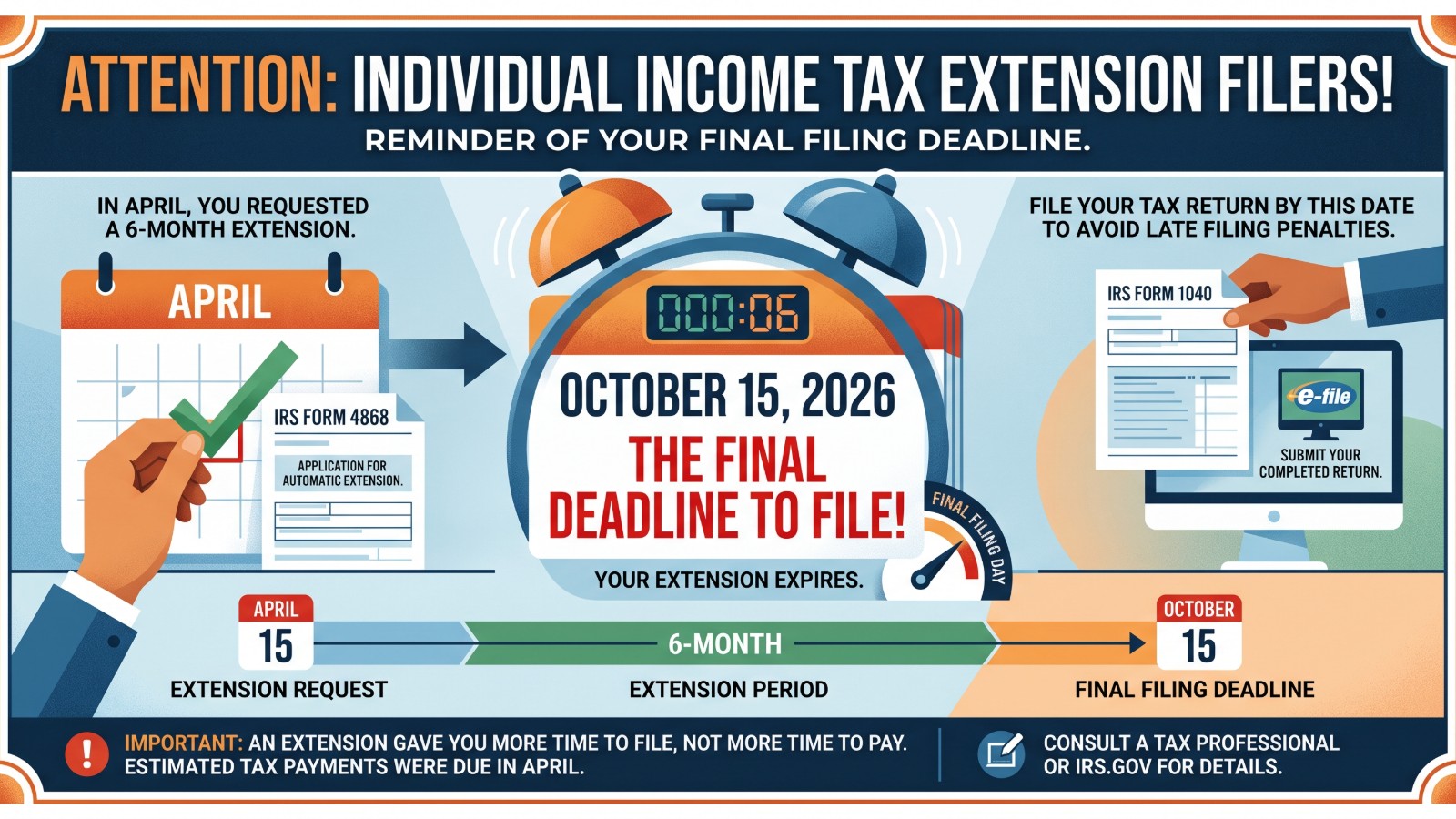
If you filed an extension for your individual tax return in April, the final deadline to submit Form 1040 is October 15, 2026. For small business owners, sole proprietors, and partners in pass-through entities, this date represents much more than just a paperwork deadline. It is the final opportunity to reconcile your corporate distribution numbers, fund specific tax-advantaged retirement accounts for the prior year, and ensure your multi-state state income reporting aligns completely with your federal filings.
An extension grants you additional time to prepare and submit your return, but it does not extend the time required to pay any taxes owed. If you underpaid your estimated tax balance back in April, interest and late-payment penalties have been accruing. Finalizing your return correctly before the October 15 cutoff allows you to cap those penalties, resolve discrepancies between your business records and personal filings, and set a clean foundation for remaining quarter estimated tax payments.
Reconciling Pass-Through Business Income and K-1s
For owners of S-corporations (S-corp) and partnerships, personal tax returns cannot be completed without accurate Schedule K-1 forms. By October 15, all business entity returns should already be processed, meaning the numbers reported on your K-1 must match your personal Form 1040 exactly.
Discrepancies between entity-level tax returns and owner-level personal returns are a frequent trigger for automated correspondence from the Internal Revenue Service (IRS) and the New Jersey Division of Taxation. Common issues include:
- Unmatched Shareholder Distributions: Ensuring that distributions drawn from the company bank account align with the tax basis calculated on your return.
- Owner Compensation: Verifying that W-2 wages paid to S-corp officer-owners meet reasonable compensation standards before closing out the year's tax calculations.
- State Pass-Through Entity Tax (BAIT) Credits: For New Jersey business owners who elected into the Business Alternative Income Tax (BAIT), confirming that the pass-through credit reported on your state return matches the credit distributed by the entity.
Reviewing these items thoroughly before submission prevents the need for costly amended returns down the road.
Finalizing Prior-Year Retirement Contributions
One of the most significant planning opportunities available up until the extended filing deadline involves funding tax-deferred retirement accounts. If your business operates as a sole proprietorship, single-member LLC, or partnership, the October 15 deadline is typically your final opportunity to make contributions to a Simplified Employee Pension IRA (SEP-IRA) for the 2025 tax year.
Contributing to a SEP-IRA directly reduces your adjusted gross income for the tax year being filed, offering an immediate dollar-for-dollar reduction in taxable income. However, the timing rules are strict:
- Fund before filing: The contribution must be deposited into the account on or before the date you physically file the extended return, but no later than October 15.
- Calculate maximum limits correctly: Net self-employment earnings determine your maximum allowable contribution. Overfunding can lead to excise tax penalties for excess contributions.
- Solo 401(k) Employer Profit-Sharing: If your Solo 401(k) plan was established prior to December 31 of the tax year, employer profit-sharing contributions can also generally be deposited up to your extended tax filing date.
Executing these contributions before finalizing Form 1040 ensures you capture every legitimate deduction available to your business under current tax codes.
Addressing Multi-State Tax Obligations
Many small business owners in the New Jersey, New York, and Pennsylvania tri-state area operate across state lines. If your business generated revenue, hired remote employees, or owned property in multiple jurisdictions, your personal income tax return must account for multi-state tax credits and filings.
When filing on extension, ensuring proper credit for taxes paid to other jurisdictions (such as paying New York state tax on income earned by a New Jersey resident) is essential to avoid double taxation. New Jersey requires specific documentation attached to Form NJ-1040 to substantiate income tax paid to out-of-state taxing authorities. Missing these attachments or failing to compute tax basis across state lines can result in balance-due notices and unexpected interest charges.
Avoiding Late Filing Penalties
It is important to distinguish between the late paying penalty and the late filing penalty. The penalty for failing to file a return by the extended due date is significantly higher than the penalty for failing to pay on time.
If you owe tax and do not file Form 1040 by October 15, 2026, the failure-to-file penalty is generally 5% of the unpaid taxes for each month or part of a month that the return is late. If you cannot pay the full balance owed, you should still file your tax return on time to eliminate the failure-to-file penalty, and then establish an installment agreement or payment plan with the IRS and state authorities.
What to Do Next
To ensure your extended individual tax return is completed accurately and efficiently before the deadline:
- Gather all outstanding Schedule K-1s, 1099 forms, and personal deduction records.
- Confirm that any planned SEP-IRA or Solo 401(k) employer contributions have been calculated and deposited into your account.
- Verify state tax credit calculations if you earned income in multiple states during the year.
If you need professional assistance reviewing your business tax reporting, calculating final retirement contributions, or filing your extended return before October 15, 2026, contact Andrew Chen CPA LLC at (908) 660-0090 or email Andy@andrewchencpa.com to schedule a consultation.
Ready to talk it through?
Pick whichever is easiest — a booked slot, a call back, or a text.
You can also text (908) 660-0090 or my cell (908) 435-1201.
Have a similar question about your business?
A short conversation is usually enough to point in the right direction.
Get the next article by email
One short, practical tax or business article a month. No spam, unsubscribe anytime.